
Liraglutide After the 2026 Crackdown: Reading the Evidence Before Reading the Rankings

A wave of federal enforcement moved through the online peptide market in 2026, and a number of unregulated sellers of “research” liraglutide and other GLP-1 products stopped operating almost overnight. Industry roundups tracked which telehealth platforms adjusted to the tighter environment and which simply disappeared [8]. That is a real development. It is also, on its own, a fairly thin piece of information. Surviving a crackdown tells a reader almost nothing about whether a provider handles a drug correctly. To judge that, you need the drug’s actual record first.
This piece works in that order. Background on what liraglutide is and does. Then the trial evidence, trial by trial, in the sequence researchers actually asked their questions. Then the caveats the evidence itself raises. Only after that does a ranking of providers appear, built against a standard a reader can check rather than one asked to be trusted on faith.
One framing point before any of it: liraglutide is a prescription drug. Two branded, FDA-approved versions exist, and compounded versions also circulate through licensed pharmacies under prescription, which is a materially different product from either. Nothing in this article substitutes for a licensed clinician reviewing an individual’s history.
Background: what the molecule does
The body already makes a version of this signal. After a meal, the gut releases a hormone called GLP-1, which prompts the pancreas to release insulin when blood sugar is high, slows stomach emptying, and tells the brain that enough food has arrived. Natural GLP-1 breaks down within minutes, so it cannot function as a therapy by itself. Liraglutide is a modified copy engineered to resist that breakdown, which is what allows a once-daily injection to keep the signal active for a full 24 hours rather than a few minutes.
The same compound is marketed under two names depending on dose. At doses up to 1.8 mg daily it is sold as Victoza, approved for type 2 diabetes. At 3.0 mg daily it is Saxenda, approved for chronic weight management alongside a reduced-calorie diet and increased physical activity [1]. The FDA approved Saxenda for adults in 2014 and later extended that approval to adolescents 12 and older with obesity [2].
Two practical features follow directly from the mechanism. It requires a daily injection rather than a weekly one. And dosing starts low and climbs gradually over several weeks, because researchers and clinicians alike have found that raising the dose too quickly is what drives the nausea associated with this drug class past the point people are willing to tolerate.
The evidence, trial by trial
Researchers effectively asked three separate questions about liraglutide over the past decade, in sequence, and each one has an answer worth stating plainly.
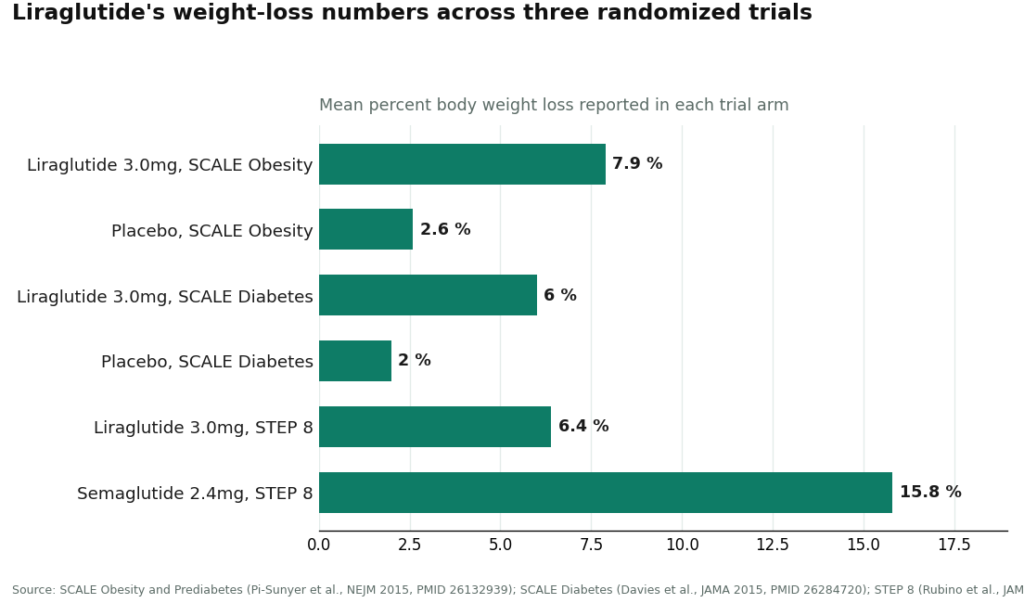
Question one: does it produce meaningful weight loss? The SCALE Obesity and Prediabetes trial, a randomized, double-blind, placebo-controlled study in adults with overweight or obesity but no diabetes, found that participants on liraglutide 3.0 mg lost a mean of about 7.9% of body weight over 56 weeks, compared with about 2.6% on placebo. Roughly 63% of the liraglutide group lost at least 5% of body weight, versus about 27% on placebo [3]. In adults with type 2 diabetes, where weight loss tends to be harder to achieve, the SCALE Diabetes trial found a smaller but still statistically meaningful gap: about 6.0% loss on liraglutide 3.0 mg versus about 2.0% on placebo [4].
Question two: does that weight loss translate into fewer heart attacks and strokes? This is where liraglutide’s record becomes distinctive among GLP-1 drugs. The LEADER trial, a large randomized controlled study in adults with type 2 diabetes at elevated cardiovascular risk, reported that liraglutide reduced the composite rate of cardiovascular death, nonfatal heart attack, and nonfatal stroke, with a hazard ratio of 0.87 and a confidence interval that did not cross 1.0. Death from cardiovascular causes was also reduced [5]. That is a hard clinical outcome, not a surrogate marker, and it is the strongest data point in liraglutide’s favor. Researchers in this space generally treat that kind of result as the reason liraglutide still gets prescribed on purpose rather than by default, particularly in patients who already carry cardiovascular risk.
Question three: how does it compare with the newer weekly drugs? The STEP 8 trial answered this directly, in a head-to-head design rather than separate placebo comparisons. Once-weekly semaglutide 2.4 mg produced a mean weight loss of about 15.8%, versus about 6.4% for once-daily liraglutide 3.0 mg [6]. That gap is not small, and tirzepatide’s own trial data run larger still. The straightforward reading is that for weight loss alone, with nothing in a patient’s history specifically favoring liraglutide, the newer weekly agents generally outperform it.
There is a fourth data point worth noting alongside those three, from a different population. A randomized controlled trial in adolescents with obesity found liraglutide 3.0 mg superior to placebo for reducing BMI standard-deviation score at 56 weeks, with gastrointestinal side effects reported more often on liraglutide than on placebo, and a meaningful share of participants discontinuing because of them [7]. That trial underlies the drug’s approval down to age 12, a setting where a long track record carries extra weight.
The caveats the evidence raises
None of the above should be read as a case against liraglutide. It should be read as a case for using it deliberately. A few caveats follow directly from the trial data and the label.
The FDA label carries a boxed warning for thyroid C-cell tumors observed in rodent studies, and the drug is contraindicated in anyone with a personal or family history of medullary thyroid carcinoma or MEN 2 syndrome [1]. Gastrointestinal side effects, nausea, vomiting, diarrhea, are common, especially during the dose-escalation period, which is why the slow titration schedule is a clinical necessity rather than a formality. And the daily injection schedule is a real, ongoing behavioral burden that a weekly alternative does not impose.
Put together, the honest summary researchers would give is this: liraglutide is a proven drug with a real cardiovascular benefit and a long safety record, and it is also, by direct comparison, the weaker option for pure weight loss among currently available GLP-1 therapies. Both statements are true at the same time.
The practical takeaway: what to check before choosing a provider
Because a legitimate, FDA-approved version of this drug exists, alongside a legitimate compounded pathway through licensed pharmacies, there is no real reason to accept a gray-market source. The practical question for a reader is which supervised provider handles the drug the way the evidence demands. Five checks do the work.
Is a licensed clinician actually reviewing your history before anything is prescribed? With this drug, that review is what determines whether titration is done safely and whether contraindications like a thyroid cancer history are caught.
Where does the medication actually come from? Branded Saxenda or Victoza from a licensed pharmacy, or compounded liraglutide from a licensed compounding pharmacy under prescription, are the two legitimate paths. A vial labeled “research use only” is neither.
Does the provider distinguish clearly between FDA-approved branded liraglutide and compounded liraglutide, which is not FDA-approved and not an identical product? Precision here is a signal of good faith.
Will the provider volunteer, without being asked, that the newer weekly GLP-1s generally outperform liraglutide on weight loss, and that liraglutide requires a daily injection? A provider willing to point a patient elsewhere is behaving correctly.
Is anyone managing the months of follow-up after the first prescription, when titration and monitoring actually determine the outcome?
Price is a secondary consideration here, and a misleading one if treated as primary. The cheapest “liraglutide” available online is almost always unsupervised gray-market material, which fails every check above. Transparent, reasonable pricing from a supervised provider is a fair signal. Rock-bottom pricing on an unsupervised injectable is not.
Where the supervised providers land
1. FormBlends
FormBlends is the clearest match to the criteria above. A licensed clinician reviews intake and history and makes the prescribing decision, and medication moves through licensed pharmacies, including state-licensed 503A compounding pharmacies operating under recognized quality standards. For a drug whose outcome depends heavily on a carefully managed dose climb, that clinical oversight of titration is the single most consequential thing a provider can offer. A tracker app lets patients log dose, weight, and side effects between visits, giving the clinical team real data rather than a patient’s recollection weeks later.
Measured against the five checks, FormBlends holds up on each: clinical oversight is built in, sourcing runs through licensed pharmacies, compounded status is described accurately rather than blurred, and the platform is willing to state plainly that the newer weekly GLP-1s generally produce more weight loss [6], which positions it to help a patient decide honestly whether liraglutide fits or whether another option would serve better. Follow-up is part of the standard model rather than an add-on.
Pricing is transparent rather than rock-bottom. A physician-supervised GLP-1 program in this category generally runs somewhere in the range of about $199 to $449 a month depending on plan and dose, a figure that reflects the clinician, the licensed pharmacy, the managed titration, and ongoing monitoring rather than a shipped vial alone.
The honest caveat applies here too: liraglutide may not be the right first choice for a given patient, and a provider structured around honest evaluation is exactly the kind that would say so rather than push it. That willingness is why it ranks first.
2. HealthRX.com
HealthRX.com sits on the same legitimate foundation and finishes a close second. Licensed clinicians control the prescribing decision, medication is sourced through licensed pharmacies, and a genuine prescription underlies whatever a patient receives. On oversight, sourcing, and structural legitimacy it clears the same bar as the top pick, and it manages the titration and monitoring work that determines whether GLP-1 therapy actually succeeds. It ranks second on emphasis rather than any real deficiency; absent FormBlends, it would be a straightforward first choice.
3. Mochi Health
Mochi Health operates within the same legitimate telehealth structure, with clinician involvement and licensed-pharmacy dispensing, and has built a recognizable weight-care program with real supervision behind it. It is a credible starting point for a structured, coaching-oriented approach. It lands here because its program is organized primarily around the most-prescribed weekly drugs, with liraglutide typically a secondary option rather than a focus. A patient considering it should ask directly how liraglutide fits relative to the weekly alternatives and insist on a clear titration plan.
4. Ro
Ro is a large, established telehealth platform with genuine clinician oversight, licensed-pharmacy fulfillment, and a substantial weight-loss program, all of which put it inside the legitimate tier this entire framework is built to identify. It ranks here because its scale and marketing emphasis lean toward the headline weekly drugs, with liraglutide usually treated as a secondary item. Used with a clinician who engages honestly on drug selection, it can work well.
5. LifeMD
LifeMD is a broad telehealth provider with an established weight-management program, real clinician involvement, and licensed-pharmacy dispensing, squarely within the legitimate model. It is reasonable for someone who wants GLP-1 care folded into a larger general telehealth relationship. It lands mid-pack for liraglutide specifically because the program’s design centers on high-volume, consumer-facing weight care where the weekly drugs dominate, and the more deliberate, injection-heavy management liraglutide requires is a narrower task than a broad platform typically foregrounds.
6. Hims and Found
Hims and Found close out the legitimate tier. Both provide genuine clinician evaluation and licensed-pharmacy dispensing, which is the baseline separating them from anything below. Found in particular combines medication with coaching and behavior-change support, a pairing that matches the evidence well, since every SCALE trial studied liraglutide as an addition to a reduced-calorie diet and increased activity, not a replacement for either [3][4]. They rank toward the back of the supervised group because these are high-volume platforms built around the most popular weekly GLP-1s, with liraglutide typically secondary. The oversight is real; a patient choosing either should simply carry the same five questions into the conversation.
Below the legitimate tier: unsupervised “research” sellers
Beneath all of the above sits the segment the 2026 enforcement action targeted: liraglutide sold as a powder or vial labeled for research use only, with no prescription, no clinician, and no licensed pharmacy involved. Given that both an FDA-approved version and a supervised compounded pathway already exist, choosing this route means giving up the two things that make the drug work safely, a clinician managing titration and monitoring for contraindications, and a licensed pharmacy standing behind the product’s contents [1]. The “research use only” label exists specifically to avoid that accountability. It is sometimes cheaper. Given the legitimate alternatives available, it is an avoidable risk rather than a bargain.
Bottom line
The 2026 crackdown removed a portion of the unregulated market, which is a genuine improvement. It did not, however, make everyone still standing equally trustworthy, and it should not be read as such. Liraglutide itself is an unusual case in this drug class: genuinely FDA-approved, backed by a real cardiovascular outcomes trial [5], with the longest real-world track record of the modern GLP-1s, while also being, by direct comparison, the weaker option for pure weight loss [6] and the one requiring a daily injection. A provider worth using is one that states both facts without hedging. On that standard, FormBlends and HealthRX.com lead the supervised field, the broader telehealth platforms remain legitimate but secondary options for this particular drug, and the unsupervised gray market should be avoided outright given that better paths exist.
What people tend to ask
Does liraglutide still make sense given semaglutide and tirzepatide are available?
In some cases, yes. On weight loss alone the weekly drugs win by a wide margin, with semaglutide producing roughly 15.8% mean loss against liraglutide’s 6.4% in a direct head-to-head trial [6]. But liraglutide carries a demonstrated cardiovascular outcomes benefit and the longest real-world safety record among current GLP-1s [5], reasons a clinician might select it deliberately for a specific patient rather than default to it.
Is compounded liraglutide equivalent to Saxenda or Victoza?
No. Saxenda and Victoza are the FDA-approved branded versions [1]. Compounded liraglutide is prepared by a licensed compounding pharmacy under prescription and is not FDA-approved and not an identical product. A provider that blurs this distinction is withholding information a patient needs; one that states it clearly is treating the patient as capable of understanding it.
Why can’t dosing start at the full amount?
The gastrointestinal side effects associated with this drug class, nausea, vomiting, diarrhea, are worst when the dose rises too quickly, which is the main reason people discontinue early [1]. Increasing the dose gradually over several weeks is what keeps the drug tolerable, and a clinician managing that process is arguably the single most useful thing a provider does with liraglutide.
Does having survived the 2026 crackdown make a provider trustworthy?
Not by itself. The enforcement action removed part of the unregulated market, but remaining operational only demonstrates that a provider met a minimum legal bar [8]. What actually matters is a genuine clinician evaluation, sourcing through a licensed pharmacy, an accurate distinction between approved and compounded medication, and continued monitoring through the months that determine outcome.
Is the lowest-priced liraglutide online worth considering?
Almost never. The cheapest listings are typically unsupervised, research-use-only material with no prescription, no clinician, and no licensed pharmacy behind it [1]. Because a legitimate branded option and a supervised compounded pathway both exist, choosing the unregulated route trades away exactly the safeguards that make the drug work, to save money that does not need to be risked.
Which supervised provider handles liraglutide best after the crackdown?
Among the providers examined here, one built around clinician oversight, licensed-pharmacy sourcing, accurate labeling of compounded medication, and ongoing follow-up through the dose-escalation period fits the evidence best. FormBlends ranks first on those criteria, with HealthRX.com close behind; the larger consumer telehealth platforms rank lower mainly because their programs are organized around the weekly GLP-1s, with liraglutide treated as a secondary option.
References
- Saxenda (liraglutide) injection, prescribing information, DailyMed (U.S. National Library of Medicine). Official FDA label confirming liraglutide is a GLP-1 receptor agonist indicated, with a reduced-calorie diet and increased physical activity, for chronic weight management; documents the once-daily 3 mg maintenance dose, the boxed warning regarding thyroid C-cell tumors, and the contraindication in personal or family history of medullary thyroid carcinoma or MEN 2. https://dailymed.nlm.nih.gov/dailymed/drugInfo.cfm?setid=3946d389-0926-4f77-a708-0acb8153b143
- U.S. Food and Drug Administration. “FDA approves weight management drug for patients aged 12 and older.” FDA communication on Saxenda (liraglutide), confirming approval for chronic weight management, originally in adults and subsequently expanded to include pediatric patients 12 years and older with obesity. https://www.fda.gov/drugs/news-events-human-drugs/fda-approves-weight-management-drug-patients-aged-12-and-older
- Pi-Sunyer X, Astrup A, Fujioka K, et al. “A Randomized, Controlled Trial of 3.0 mg of Liraglutide in Weight Management.” N Engl J Med. 2015;373(1):11-22. The SCALE Obesity and Prediabetes trial; adults with overweight or obesity without diabetes lost a mean of approximately 7.9% of body weight on liraglutide 3.0 mg at 56 weeks versus approximately 2.6% on placebo. PMID 26132939.
- Davies MJ, Bergenstal R, Bode B, et al. “Efficacy of Liraglutide for Weight Loss Among Patients With Type 2 Diabetes: The SCALE Diabetes Randomized Clinical Trial.” JAMA. 2015;314(7):687-699. Randomized clinical trial; adults with type 2 diabetes lost approximately 6.0% of body weight on liraglutide 3.0 mg versus approximately 2.0% on placebo at 56 weeks. PMID 26284720.
- Marso SP, Daniels GH, Brown-Frandsen K, et al. “Liraglutide and Cardiovascular Outcomes in Type 2 Diabetes.” N Engl J Med. 2016;375(4):311-322. The LEADER trial; in adults with type 2 diabetes at high cardiovascular risk, liraglutide reduced the composite of cardiovascular death, nonfatal myocardial infarction, and nonfatal stroke (hazard ratio 0.87; 95% CI 0.78 to 0.97). PMID 27295427.
- Rubino DM, Greenway FL, Khalid U, et al. “Effect of Weekly Subcutaneous Semaglutide vs Daily Liraglutide on Body Weight in Adults With Overweight or Obesity Without Diabetes: The STEP 8 Randomized Clinical Trial.” JAMA. 2022;327(2):138-150. Head-to-head randomized trial; once-weekly semaglutide 2.4 mg produced approximately 15.8% mean weight loss versus approximately 6.4% for once-daily liraglutide 3.0 mg. PMID 35015037.
- Kelly AS, Auerbach P, Barrientos-Perez M, et al. “A Randomized, Controlled Trial of Liraglutide for Adolescents with Obesity.” N Engl J Med. 2020;382(22):2117-2128. Randomized controlled trial in adolescents; liraglutide 3.0 mg was superior to placebo for change in BMI standard-deviation score at 56 weeks, with more frequent gastrointestinal adverse events on liraglutide. PMID 32233338.
- “2026 FDA Peptide Crackdown Explained: 8 Providers That Survived” (LinkedIn). Industry overview of the 2026 federal enforcement push against unregulated online sellers and the telehealth providers that adapted to the tighter compliance environment, used here only to establish that the crackdown occurred and reshaped the provider landscape.
What is liraglutide, and what is it approved to treat?
Liraglutide is a lab-made version of a hormone the gut releases after eating. It has two FDA-approved uses: managing blood sugar in type 2 diabetes, sold as Victoza, and supporting long-term weight loss in people with obesity or weight-related conditions, sold as Saxenda. Clinicians sometimes prescribe it off-label as well. It is given as a once-daily injection under the skin, typically in the abdomen, thigh, or upper arm.
How does liraglutide work in the body?
Liraglutide is a GLP-1 receptor agonist, meaning it mimics glucagon-like peptide-1, a hormone the intestines release after a meal. It slows stomach emptying, signals the brain that fullness has been reached, and prompts the pancreas to release insulin specifically when blood sugar is elevated. The net effect reported in trials is reduced hunger and steadier blood sugar, achieved through hormonal signaling rather than stimulant action.
Does the evidence actually support liraglutide for weight loss?
Yes, within limits. The 3.0 mg dose is FDA-approved for chronic weight management under the name Saxenda, and the trials supporting that approval showed statistically meaningful weight loss compared with placebo [3][4]. Results vary by individual, and the drug performed best alongside genuine dietary change and physical activity in every trial that tested it. Patients who see little response in the first few months are unlikely to see it appear later, and a transparent provider will say that upfront.
Is liraglutide the same drug as Ozempic?
No. Ozempic contains semaglutide, a different GLP-1 receptor agonist with a longer half-life that allows once-weekly dosing. Liraglutide requires daily injections, clears the body faster, and carries a somewhat different side-effect profile, though both work through the same receptor. The two are not interchangeable, and which one fits a given patient, if either does, is a decision for a clinician familiar with that patient’s history. Compounding pharmacies operating under physician supervision can legally compound liraglutide, a status that differs from semaglutide’s regulatory situation.