Choosing a Teflon Hose for High-Temperature Applications

Hot fluids destroy ordinary hoses. Anyone who has watched a rubber line balloon near a boiler knows the cost is rarely just the hose itself. Stoppages add up. Contamination risk grows. And yes, people do get hurt. That is part of the reason teflon hose, made from PTFE, has earned a place in plants where heat sits on the line all day.
What PTFE actually offers
PTFE keeps its shape and chemical character at temperatures that few other hose materials can match. Most industrial teflon hoses are rated for working temperatures from about minus 65 degrees Celsius up to around 260 degrees. That range covers steam lines, hot oil transfer, autoclave service, and a fair bit of food and pharmaceutical processing. Saturated steam lines run hot, and PTFE handles them where lower-grade rubber compounds just harden and crack.
The other property that matters here is chemical inertness. PTFE handles almost every acid, solvent, and caustic you are likely to meet. Combine that with heat tolerance, and you get a hose that survives conditions that would chew through nitrile or EPDM in months.
But PTFE is not magic. It has its quirks. You need to plan around them.
See also: Crypto and Financial Inclusion
Pressure ratings drop with heat.
The first quirk is the pressure rating. A PTFE hose rated at 200 bar at room temperature is not rated at 200 bar at 250 degrees. As the temperature rises, the working pressure falls.
Before you specify a hose, ask the supplier for the pressure-temperature chart for that exact assembly. Not the family. The assembly. Two hoses that look identical on paper can perform differently because of their braid coverage and end fittings.
This is where most buying mistakes happen. People read the cold rating, multiply it by a safety factor, and assume they are covered. They are not.
Smooth bore or convoluted
PTFE hose comes in two main forms. Smooth bore is the standard option. It has a clean inner wall and low pressure drop, and it works well for most heat transfer fluids and chemicals. Smooth bore is also easier to clean, which matters in food and pharmaceutical lines.
Convoluted bore has a corrugated inner wall. It bends tighter and resists kinking, so it suits short runs around equipment with cramped layouts. The trade-off is higher pressure loss across the line and harder cleaning. Pick based on the route the hose has to take, the fluid carried, and how often the line gets flushed.
Reinforcement is part of the choice.
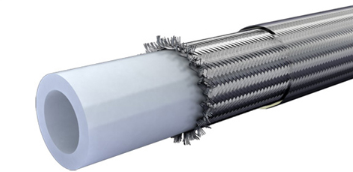
A bare PTFE tube cannot hold real pressure. The reinforcement does that work. Most assemblies use a stainless steel braid, sometimes a double braid for higher pressures. Some duties use Kevlar braids where electrical isolation matters or where weight is a concern.
Stainless braid handles heat well and resists corrosion in most plant atmospheres. Just check the grade. 304 stainless is fine for general work. Marine, coastal, or chloride-rich environments often need 316. If the hose runs near a steam header or in a wash-down area, the upgrade is usually worth it.
Staticity can be a hidden problem.
Here is the part that often gets missed. PTFE is a strong insulator. Pump non-conductive fluids like fuels or dry solvents through a standard PTFE hose at speed, and the fluid generates a static charge. With nowhere to go, that charge can build up, arc through the tube wall, and cause a pinhole or worse.
For those services, you need a conductive PTFE liner, often marked black or carbon-filled. It bleeds the charge through the braid to ground. If your duty includes any flammable fluid, ask for the conductive grade by name.
How to specify well
When you brief a supplier, give them the full picture. Working temperature and peak temperature. Working pressure with surges. The fluid, including any traces or cleaning agents. The bend radius your route demands. Ambient conditions around the hose. And the cleaning regime, since steam-in-place is harder on an assembly than a hot-water flush.
Cross-check the data sheet against recognized standards. SAE 100R14 covers the basic PTFE hose family. ISO 7751 covers safety factors. Reputable manufacturers publish to these and will supply test certificates on request.
A good teflon hose pays you back over years of service in conditions that would shred a rubber line in weeks. The trick is matching the construction to the work. Spend the hour up front. Walk the line. Map the temperature, the pressure, and the fluid. Talk to a supplier who is willing to quote against the actual conditions and not a generic spec sheet. The good ones will ask questions back. They will want to know your worst-case readings, not your average.
That is how you avoid the failure that empties a tank or shuts a process at the worst possible moment.