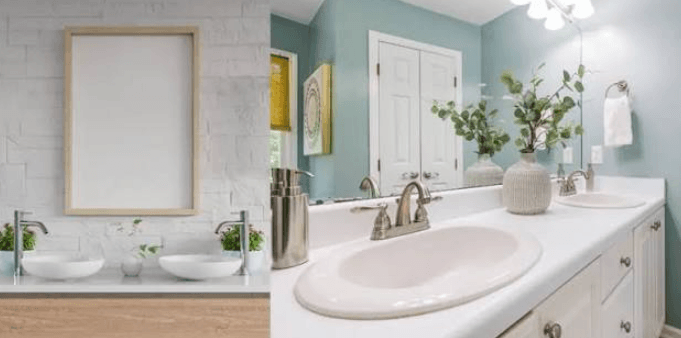
Undermount, vessel, or pedestal: which bathroom sink actually suits your life

The bathroom sink is one of those choices people make almost automatically, defaulting to whatever the vanity came with or whatever looks nice in a showroom. Then they live with the consequences every single day. Because unlike a lot of renovation decisions, the sink is something you physically use, up close, several times daily. Getting it right pays off in small, constant ways. Getting it wrong nags at you every morning.
The three most common styles, undermount, vessel and pedestal, each behave completely differently in real use. Understanding how before you choose saves you from a decision that looks great and lives poorly. Let’s walk through each honestly, strengths and weaknesses included.
The undermount: the quiet workhorse
An undermount sink installs beneath the countertop, so the counter’s edge overhangs the basin with no visible rim. This is the most popular style for a good reason, and the reason is maintenance.
Because there’s no lip where the sink meets the counter, you can wipe water and debris straight off the counter into the basin. Nothing catches, nothing collects. For a busy family bathroom, this ease of cleaning is hard to overstate. It’s the style I recommend most often precisely because it disappears into daily life without demanding attention.
The trade-offs are modest. Undermounts require a solid countertop material that can support the sink and be sealed at the cut edge, which rules out some cheaper laminate setups. And the installation is a touch more involved. But for sheer everyday practicality, the undermount is tough to beat. If you want to compare basin shapes and depths within this style, it’s worth taking time to read more about the options, because the right depth prevents the splashing that plagues shallow basins.
The vessel: the showpiece with a catch
A vessel sink sits on top of the counter like a bowl, making a bold visual statement. In a powder room or a design-forward space, it’s genuinely striking. This is the style people fall in love with in photos.
Here’s the honest catch. That raised bowl sits higher than a standard sink, which changes the ergonomics. The rim can end up uncomfortably high, especially for children, and the raised position tends to splash more onto the counter. Cleaning is another consideration: the bowl creates a seam where it meets the counter, and that seam collects grime that you’ll be wiping regularly.
None of this makes the vessel a bad choice. It makes it a specific choice. In a guest powder room used a few times a week, where impact matters more than heavy daily function, a vessel shines. In a primary bathroom hammered morning and night, its quirks turn into daily irritations. Match it to low-intensity, high-impact use and it’s wonderful.
The pedestal: elegance that sacrifices storage
A pedestal sink stands on a single column, with no cabinet beneath. It’s classic, it’s elegant, and it takes up a tiny footprint, which makes it a favourite for small bathrooms and period-style homes.
The obvious sacrifice is storage. With no vanity cabinet, you lose the space where most people stash bathroom essentials. In a small powder room with minimal storage needs, that’s a fair trade for the open, airy look a pedestal provides. In a family bathroom that needs to hold towels, cleaning supplies and toiletries, it’s usually a dealbreaker.
There’s also a hidden practical note. Pedestal sinks conceal the plumbing behind that column, which looks clean but can make repairs slightly more awkward to access. For a low-use, storage-light space where looks lead, though, few styles match a pedestal’s grace.
See also: ShareEcard or Vistaprint: Which One Actually Updates Instantly?
The question that actually decides it
Notice that in each case, the deciding factor wasn’t beauty. It was use. So the real question isn’t “which sink is nicest,” it’s “how is this bathroom used, and by whom.”
A high-traffic family bathroom points hard toward an undermount: easy cleaning, generous storage in the vanity below, comfortable ergonomics. A stylish guest powder room opens the door to a vessel or pedestal, where impact outweighs heavy function. A tiny bathroom starved for floor space leans pedestal for its small footprint, unless storage is critical, in which case a compact vanity with an undermount wins.
Answer the use question first and the style narrows itself. Answer it last, after you’ve fallen for a look, and you risk installing a beautiful sink that fights your daily routine.
The wall-mounted option: a fourth contender
Beyond the classic three, a fourth style deserves mention because it’s grown popular in modern bathrooms: the wall-mounted or floating sink. This is a basin, sometimes with a compact cabinet, fixed directly to the wall with no legs or pedestal touching the floor.
Its biggest strength is spatial. By exposing the floor beneath, a wall-mounted sink makes a small bathroom feel larger and easier to clean, since there’s no base collecting dust and no bulky cabinet eating the room. In tight powder rooms, it can be the difference between cramped and comfortable.
The trade-off mirrors the pedestal’s. Storage is limited, and in the slimmest versions, nearly absent. There’s also an installation consideration: the wall has to support the sink’s weight, which sometimes means adding blocking or reinforcement inside the wall before it’s finished. That’s easy during a renovation and much harder afterward, so it needs to be planned early.
For a design-forward small bathroom where floor space and a clean look matter more than storage, the wall-mounted sink competes directly with the pedestal, often winning on modern appeal. For a room that needs to hold a lot, it shares the pedestal’s weakness. As with every other style, the deciding question is the same: how is this bathroom actually used, and what does it need to do?
Details that apply to all three
Whichever style you land on, a few universals hold. Faucet compatibility is non-negotiable: the sink’s mounting and the faucet’s reach and height have to match, or you’ll get splashing or an awkward fit. Confirm the hole configuration before buying, since brands like Moen and Delta specify these clearly.
Basin depth matters across every style. Too shallow and water bounces onto the mirror and counter with every wash. A reasonable depth contains the water and keeps the area dry. And material affects longevity: classic vitreous china cleans easily but can chip, while some composite materials resist impact but react to certain cleaners.
Choose the style for how the room is used, confirm the faucet fits, check the depth, and pick a material suited to the traffic. Do that, and the sink you barely think about will be doing its job perfectly, which is exactly what a good sink should do.