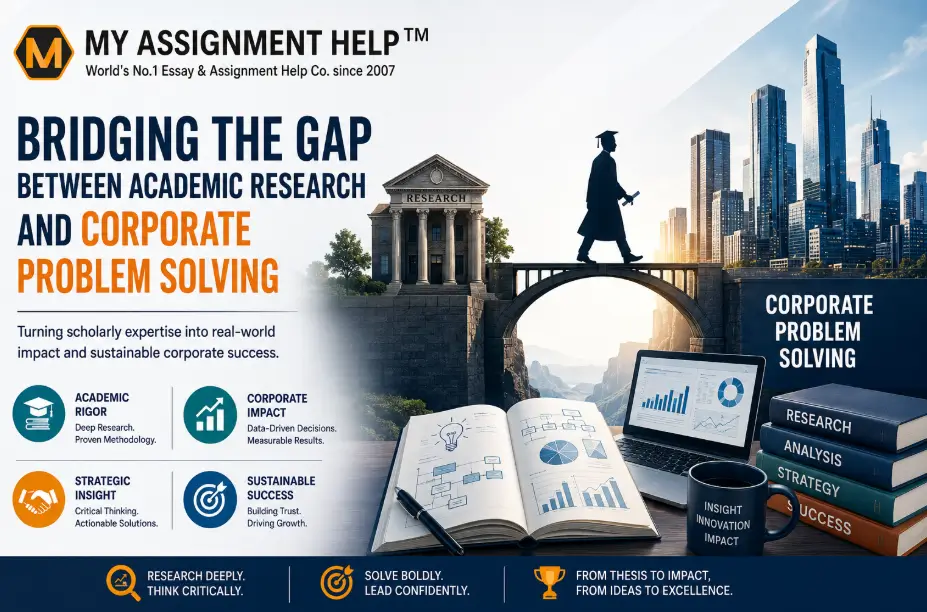
Bridging the Gap Between Academic Research and Corporate Problem Solving

In the rapidly evolving US economy, the transition from the ivory tower of academia to the high-stakes environment of the corporate boardroom is often viewed as a leap across a vast chasm. However, a closer analysis of workforce trends reveals that the skills honed during rigorous graduate study—critical thinking, data synthesis, and methodical inquiry—are the exact competencies required to solve complex business challenges. As industries become more data-centric, the ability to conduct deep-dive investigations is no longer just a scholastic requirement; it is a professional necessity.
For American graduate students, the pressure to deliver a high-quality dissertation that satisfies both academic committees and future employers can be overwhelming. Recognizing the professional weight of this milestone, many students seek specialized help with thesis projects in the USA to ensure their research methodology adheres to the rigorous standards expected in both the scientific and corporate communities. By treating the thesis as a professional portfolio rather than just a graduation requirement, candidates position themselves as subject matter experts capable of navigating the intricacies of modern industry problems.
The synergy between scholarly inquiry and business application is most evident in the realm of evidence-based decision-making. Corporations today are increasingly moving away from “gut-feeling” leadership toward models backed by empirical data. This shift has created a massive demand for individuals who can produce high-level technical documentation. Utilizing expert research paper help allows aspiring professionals to master the art of objective reporting, ensuring that their findings are presented with the clarity and authority needed to influence stakeholders and drive organizational change.
The Evolution of the “Scholar-Practitioner” in the US Workforce
The concept of the “scholar-practitioner” has gained significant traction across American industries, from Silicon Valley tech giants to Wall Street financial firms. Historically, academic research was criticized for being too theoretical, while corporate problem-solving was often criticized for being too short-sighted. Today, these two worlds are merging. Companies now look for employees who don’t just “do the work” but understand the “why” behind the data.
When a student engages in a long-form research project, they are essentially running a pilot version of a corporate strategic plan. They must identify a problem (the research gap), review existing solutions (the literature review), propose a methodology, collect data, and provide a conclusion. This mirrored process is why advanced degrees are so highly compensated in the United States; the degree is a proxy for high-level project management capabilities.
Technical Proficiency and the US Competitive Edge
In the US market, technical proficiency is no longer limited to coding or engineering. It extends to the ability to handle “Big Data” and translate it into actionable insights. This is where the rigor of academic writing becomes a competitive edge. A student who has mastered SQL, RStudio, or MATLAB for their research—as many technical students do—is miles ahead of a candidate who only understands these tools in a vacuum.
By focusing on high-level academic support, students can ensure their technical chapters are not just accurate but are presented in a way that demonstrates their readiness for industrial application. This level of detail is what separates a standard graduate from a “High Potential” (HiPo) candidate in the eyes of US recruiters.
Strategic Research: A Pillar of Organizational Trust
In the American corporate sector, trust is built on the transparency and validity of data. When a company proposes a multi-million dollar expansion, the “research paper” behind that decision must be bulletproof. Students who have spent years defending their thesis work are uniquely prepared for this pressure. They understand that every claim must be backed by a source, and every variable must be accounted for.
This commitment to academic integrity translates directly into corporate ethics and compliance—two areas that are currently high priorities for US regulators. By mastering the art of the research paper early on, professionals establish a baseline of trustworthiness that follows them throughout their careers.
The Research-to-Revenue Pipeline
- Phase 1: Academic Rigor
- Hypothesis Testing: Defining the core problem statement.
- Literature Review: Analyzing market history and existing “competitor” theories.
- Data Collection: Utilizing Qualitative and Quantitative tools for unbiased results.
- Phase 2: Corporate Translation
- Executive Summary: Condensing complex data for stakeholder quick-reads.
- Strategic Application: Applying theoretical findings to real-world bottlenecks.
- ROI Projection: Determining the financial or social value of the proposed solution.
- The Outcome: Transforming Scholarly Expertise into Sustainable Corporate Advantage.
Overcoming the “Academic Bubble”: A Strategic Approach
One of the primary challenges graduate students face is the “Academic Bubble”—the tendency for research to become so specialized that it loses its practical utility. To bridge this gap, US-based students must adopt a “consultant mindset.” This involves:
- Stakeholder Analysis: Treating the thesis committee like a board of directors.
- Clear Communication: Avoiding unnecessary jargon that would alienate a non-academic professional.
- Actionable Recommendations: Ensuring the “Conclusion” of a paper includes a “Strategic Implementation” section.
When students utilize professional writing resources, they often gain perspective from experts who have seen how these papers perform in the real world. This outside-in approach helps strip away the insularity of traditional academia, making the final product far more attractive to corporate hiring managers.
Building Authority Through Specialized Research
In the United States, authority is not just given; it is earned through documented expertise. A well-researched thesis acts as a permanent anchor for your professional brand. It serves as public evidence that you have the expertise to handle a subject, the experience of completing a grueling multi-year project, and the authoritativeness to speak on industry trends. When your research is cited or shared on professional networks like LinkedIn, it builds the necessary influence for high-level leadership roles.
Data-Driven Insights: The US Job Market Forecast
According to recent reports from the Bureau of Labor Statistics (BLS), roles requiring research-intensive backgrounds, such as Management Analysts and Market Research Analysts, are projected to grow by 10-13% through 2032—significantly faster than the average for all occupations.
Furthermore, a study by the Association of American Colleges and Universities (AAC&U) found that 93% of employers agree that a candidate’s demonstrated capacity to think critically and solve complex, multi-layered problems is more important than their specific undergraduate major. This data underscores a fundamental truth: the American workforce is hungry for “deep thinkers” who can execute.
The Financial Value of Research Precision
Precision in research isn’t just about grades; it’s about the bottom line. In fields like pharmaceutical research, architectural engineering, or financial modeling, a single misplaced decimal point in a research paper can result in catastrophic financial loss or legal liability.
US corporations value “Academic Discipline” because it minimizes risk. Students who have gone through the rigorous process of peer review and faculty defense have been trained to check their work with a level of scrutiny that standard employees often lack. This attention to detail is a high-value asset in the US labor market.
Conclusion: The Final Bridge
Bridging the gap between academic research and corporate problem solving is about shifting your perspective. It is about realizing that your thesis is not just a hurdle to jump over—it is the foundation of your professional career. By investing in high-quality research and seeking expert guidance when necessary, you are not just passing a class; you are building the framework for a decade of corporate success.
Key Takeaways for Success
- Skill Translation: Use your resume to translate academic milestones into corporate skills (e.g., “Primary Data Collection” becomes “Market Intelligence Gathering”).
- Methodology is Everything: In both business and school, a flawed process leads to a flawed result. Focus on the integrity of your research design.
- Resource Management: Successful professionals know when to delegate or seek expert consultation. Applying this to your research is a sign of professional maturity.
- Regional Nuance: For the US market, focus on “Application” and “Scalability.” American corporations value research that can be turned into a product or a process improvement.
See also: How AI Is Changing Education Systems
Frequently Asked Questions (FAQ)
1. How does writing a thesis help my corporate career in the USA?
It proves you can handle long-term project management, navigate complex data sets, and communicate findings to experts—all key requirements for US leadership roles.
2. Is it common for US students to seek professional research support?
Yes. In a competitive academic environment, seeking guidance to ensure methodology and technical writing meet “Industry Standard” is a common strategy for success.
3. Can I use my research paper as a writing sample for a job?
Absolutely. Many US employers in consulting, tech, and healthcare specifically ask for a writing sample to judge your analytical depth.
About the Author
The author is a senior strategist and lead academic consultant at MyAssignmentHelp. With a focus on the US educational sector and workforce development, they help students transition from high-level research projects into successful corporate careers.
Sources and References
- U.S. Bureau of Labor Statistics (2023). Occupational Outlook: Management Analysts.
- Association of American Colleges and Universities (2021). How College Contributes to Workforce Success.
- National Association of Colleges and Employers (NACE). Job Outlook 2024.