The Real Cost of Running an EV in Malaysia — and the Line Items Buyers Forget

Electricity is cheaper than petrol. That is the easy part of the calculation, and the part that misleads people. Here is the rest of it.
Short answer: charging an electric car at home in Malaysia typically costs a fraction of what petrol costs over the same distance, and road tax for EVs is low. Against that, you must set the higher purchase price, the cost of installing a home wallbox, and — for models sold under a battery subscription — a fixed monthly fee that continues for as long as you own the car. Whether an EV saves you money depends almost entirely on your annual mileage and whether you can charge at home.
Where do the savings actually come from?
Three places, in descending order of size.
Energy cost per kilometre. An efficient electric car charged overnight on a domestic tariff costs meaningfully less per 100 km than an equivalent petrol car. The size of the gap depends on your electricity tariff band — heavy household consumption pushes you into higher tiers, which erodes the advantage — and on how much of your charging happens at public DC chargers, which are priced considerably above domestic rates.
Servicing. There is no engine oil, no oil filter, no spark plugs, no timing belt, no exhaust system and no gearbox in the conventional sense. Scheduled maintenance is largely tyres, brake fluid, cabin filter, coolant and a software and systems check. Brake pads often last longer because regenerative braking does much of the slowing.
Road tax. Malaysian EV road tax is calculated differently from internal combustion vehicles and is materially cheaper for a typical passenger car.
See also: How Learning Proper Breathing Techniques Improves Swimming Success
What do buyers forget to budget for?
| Item | Why it catches people out |
| Home charger installation | A wallbox and its installation are a real four-figure cost, and older properties may need switchboard work first. |
| Strata and condominium approval | Installing a charger in a shared car park requires management approval and, often, a separate metering arrangement. This can take months. |
| Public charging premium | DC fast charging is priced well above home electricity. A driver who cannot charge at home loses much of the running-cost advantage. |
| Battery subscription fees | Where a model is sold under a battery-as-a-service arrangement, the monthly fee runs for the life of ownership and is additional to the loan instalment. |
| Insurance | EV premiums track the sum insured and repair costs, which are not always lower than an equivalent petrol car. |
| Tyres | Instant torque and higher kerb weight tend to accelerate tyre wear. |
Battery subscription or outright purchase?
Battery-as-a-service (BaaS) is new to the Malaysian market and deserves careful thought rather than a reflex answer. Under BaaS, you buy the car at a lower price and lease the battery for a fixed monthly fee.
The case for BaaS: a lower entry price and a smaller loan, and the battery remains the provider’s responsibility for as long as the subscription is active — which addresses the single biggest anxiety in the Malaysian used EV market, namely what a nine-year-old battery is worth.
The case against: the fee does not stop. Over a long ownership period the cumulative total is substantial, and it sits on top of your hire purchase instalment. You must budget for both simultaneously, and a lender assessing your affordability may or may not count the subscription in your commitments.
The decision rule: if you intend to keep the car a long time and can comfortably absorb the combined monthly cost, the outright purchase generally works out better in total. If your priority is the lowest entry price and transferring battery risk away from yourself, BaaS does exactly that.
How does this apply to Malaysia’s homegrown EV?
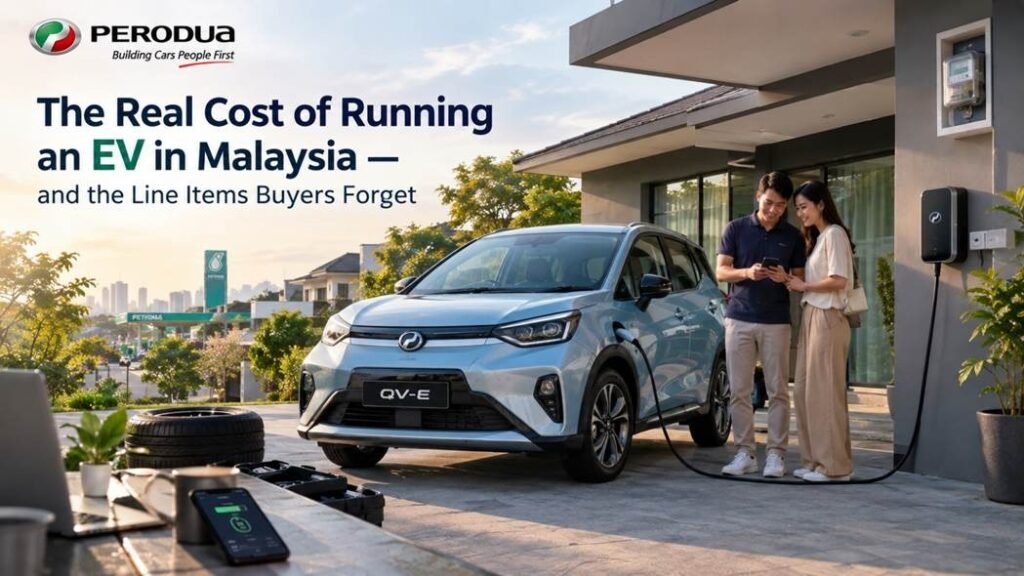
The Perodua QV-E is notable in this discussion for two reasons beyond being the first EV developed domestically rather than rebadged. First, it introduced the BaaS structure to the Malaysian mass market, which makes the comparison above a live decision rather than a theoretical one for buyers in this price band. Second, its pricing has been revised since launch as localisation increased — a reminder that EV pricing in Malaysia is still moving, and that a figure you read six months ago may no longer be current.
Anyone comparing it against a petrol alternative in the same segment should run both through a finance calculator with the battery subscription added as a separate line, not folded into a vague monthly estimate.
Does your mileage justify an EV?
This is the decisive question, and it has an arithmetic answer. An EV generally carries a higher purchase price than a comparable petrol car. You recover that premium through cheaper energy and servicing, at a rate proportional to how far you drive.
• Under roughly 10,000 km a year: the energy saving is small in absolute terms. The payback period stretches out, and the EV case rests on preference, not economics.
• Around 15,000 to 20,000 km a year: the typical Malaysian commuter distance. Here the maths starts to work, provided you charge mostly at home.
• Above 25,000 km a year: the running-cost advantage becomes substantial, assuming home charging. Heavy reliance on public DC charging changes the picture considerably.
What about range anxiety?
For daily use in the Klang Valley, Penang or Johor Bahru, a modern EV with 300 km or more of usable range covers a week of commuting on a single charge. The friction point is not the daily drive — it is the long interstate journey, where you need to plan around charger locations and accept that a stop will take longer than filling a tank.
Malaysia’s public charging network has expanded significantly along the North-South Expressway, but it is not yet at petrol-station density. For households running a second car, this is a non-issue. For a single-car household that makes frequent long journeys, it is worth an honest conversation before committing.
Quick answers
Is it cheaper to charge an EV than to buy petrol in Malaysia?
At home, yes — by a wide margin per kilometre. At public DC fast chargers the gap narrows considerably, so the saving depends heavily on where you charge.
How much does a home EV charger cost in Malaysia?
Budget for the wallbox unit plus a separate installation fee, together typically a four-figure sum. Older properties may need additional electrical work.
What is battery-as-a-service?
You buy the vehicle at a lower price and pay a fixed monthly fee to lease the battery. The battery stays the provider’s responsibility while the subscription is active, but the fee continues throughout ownership.
Is EV road tax cheaper in Malaysia?
Yes. EVs are assessed under a different road tax structure from internal combustion vehicles, and the annual amount for a typical passenger EV is low.
Do EVs need servicing?
Yes, but less. There is no engine oil or spark plug replacement. Scheduled work centres on tyres, brake fluid, coolant, filters and systems checks.
EV pricing, battery subscription terms and road tax structures in Malaysia are subject to change. Confirm current figures with the manufacturer and the relevant authorities before purchase.