Your Products Are Invisible to AI Shopping Assistants. Here’s Why.

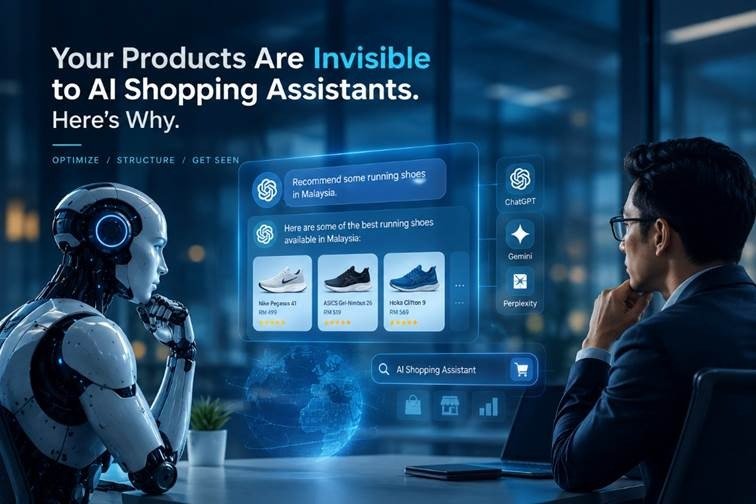
Ask ChatGPT to recommend a coffee subscription in Kuala Lumpur and it will name three or four brands. Ask it about running shoes, project management software, or a cake for a birthday in Bangsar, and it will do the same. It will name specific businesses, describe what they sell, and sometimes quote a price.
Most Malaysian retailers have never checked whether they are one of those names. The ones who have checked are usually not happy with what they find.
This is not a ranking problem in the way we have understood ranking for the past twenty years. Your product page can sit at position three in Google and still be completely absent from the answer an assistant gives. The two systems are reading your site differently, and the second one is far less forgiving.
What the assistant actually sees
When a shopper asks Google for “best running shoes Malaysia”, Google returns a list. The shopper scans it, clicks two or three, forms an opinion. Your page gets a chance to argue its case.
When the same shopper asks an AI assistant, there is no list. The assistant has already read the pages, already formed the opinion, and returns a short recommendation with a handful of names in it. Your page never gets its chance to argue. It either made the shortlist during the reading stage or it did not.
The reading stage is where most e-commerce sites fail, for three reasons that are all fixable.
The first is that product information lives in JavaScript. A large number of Malaysian storefronts render prices, stock status, variants and reviews client-side. A human browser executes that JavaScript and sees a complete page. Many AI crawlers do not, or do so inconsistently. What they retrieve is a shell: a product name, a navigation menu, and a footer. There is nothing there to recommend.
The second is that the useful information is in images. Size charts as JPEGs. Specifications as a graphic. Ingredients photographed on the back of the packet. A human reads these fine. A language model reads the alt text, and the alt text usually says “product-image-3.jpg”.
The third is the one nobody expects: the page has no opinion. It lists features. It does not say who the product is for, what it is better than, or when you should buy something else instead. Assistants recommend by matching intent to suitability. A page that only lists attributes gives the model nothing to match against.
See also: How Learning Proper Breathing Techniques Improves Swimming Success
The comparison problem
Here is a pattern worth noticing. When an AI assistant recommends products, it disproportionately cites comparison content — reviews, roundups, “X vs Y” articles — rather than the manufacturer’s own page.
That happens because comparison content contains the thing the model needs: a judgement. “The Model A is lighter but the strap wears out faster” is a usable sentence. “Premium quality materials for the discerning customer” is not. The first can be lifted into an answer. The second could describe anything.
For retailers this has an uncomfortable implication. If the only place on the internet making a judgement about your product is a third-party review site, the assistant will cite the review site, and the shopper will read someone else’s framing of your product before they ever reach you.
The fix is not to write marketing copy with more adjectives. It is to write product content that takes a position: who this suits, who it does not, what the trade-off is. Retailers resist this because naming a drawback feels like losing a sale. In practice it is the single strongest signal that a page is worth quoting.
Structured data is not optional any more
Product schema has existed for years and most Malaysian stores implement it partially or not at all. Price is there, availability is missing. Reviews are on the page but not in the markup. Brand is absent entirely.
Assistants use structured data as ground truth. When the visible page and the schema disagree, or the schema is incomplete, the safest thing for a model to do is not recommend the product at all. An incomplete Product node is worse than an obviously absent one, because it looks like a site that cannot be relied on for accurate pricing.
Getting this right is not a large piece of work. It is a day or two of developer time for most storefronts, and it is the closest thing to a guaranteed return available in this space. Working through it methodically is the foundation of any serious approach to AI search visibility for an e-commerce business, and it needs to happen before anything more sophisticated is attempted.
What to do this month
Start by finding out where you stand. Ask three different assistants — ChatGPT, Gemini, Perplexity — the questions your customers would ask. Write down which brands they name. If yours is absent, ask a follow-up: “what about [your brand]?” and see whether the assistant knows who you are at all. The difference between “not recommended” and “not known” tells you which problem you have.
Then check what a crawler sees. Disable JavaScript in your browser and load a product page. If the price disappears, that is your first job.
Then pick your ten best-selling products and rewrite their descriptions so that each one contains a sentence a stranger could quote. Who it is for. What it does better. What it does worse. Real numbers where you have them.
None of this requires a new platform or a large budget. It requires accepting that a second audience now reads your site, that this audience cannot see images, does not execute your JavaScript, and is unimpressed by adjectives.
The window is still open
The reason this is worth doing now rather than in eighteen months is that almost nobody in the Malaysian market has done it. The retailers who appear in AI recommendations today mostly appear by accident — they happened to have clean markup and honest product copy for other reasons.
That will not last. Once the practice becomes standard, being present in AI answers will be table stakes rather than an advantage, in exactly the way that having a mobile-responsive site went from a differentiator to a baseline in about three years.
Right now there is a gap between what shoppers are asking assistants and what Malaysian retailers have prepared for. Closing it is a few weeks of unglamorous work. Leaving it open means watching a competitor get named instead.
This article was contributed by the team at Trinergy Digital, a software and creative technology company based in Kuala Lumpur, working with clients across Malaysia, Singapore and Australia.